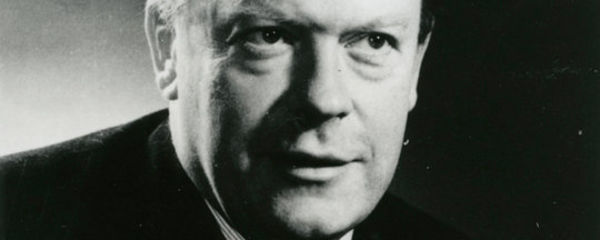
Letters and papers of Edward Charles Gurney Boyle, Baron Boyle of Handsworth
Contains digital mediaDetails
Type of record: Archive
Title: Letters and papers of Edward Charles Gurney Boyle, Baron Boyle of Handsworth
Classmark: MS 660
Creator(s): Boyle of Handsworth, Edward Boyle Baron (1923-1981)
Date(s): 19--
Language: English
Size and medium: Over 50,000 items in 161 boxes
Persistent link: https://explore.library.leeds.ac.uk/special-collections-explore/5493
Description
EDWARD CHARLES GURNEY BOYLE, baron Boyle of Handsworth, PC, CH, was born in 1923 the eldest child of Sir Edward Boyle, 2nd bart. (1878-1945), a lawyer and prominent member of the Balkan Committee, and of Beatrice (nee Greig) who died in 1961. Lord Boyle is referred to throughout this catalogue as 'EB'. His grandfather, Sir Edward Boyle, 1st bart., had been Conservative MP for Taunton from 1906 to 1909. Lord Boyle very kindly gave papers of his grandfather's political agent, Louis Henry Hayter, and correspondence between Mary Edith Durham and his father on Balkan affairs to the Brotherton Library in 1976 (now respectively MSS 406 and 405). Edward Boyle was educated at Eton and Christ Church, Oxford, though the war intervened between his school-days and his undergraduate career. During the war he served principally in intelligence at Bletchley Park. He went up to Oxford in 1945 and became president of the Oxford Union Society in 1948. His first employment after graduating was as assistant
editor of The National and English Review but his sights were set on a political career and he had been selected as a potential Parliamentary candidate by the Conservative Central Office in 1947. After unsuccessfully contesting Perry Barr (Birmingham) in February 1950 he was elected Conservative MP for the nearby Handsworth constituency in November 1950 and he retained the seat until he left politics in 1970. Then he first entered the House of Commons he was its youngest member. He obtained his first government post in 1954 when he was appointed Parliamentary Secretary at the Ministry Supply. Later as Economic Secretary to the Treasury he travelled widely overseas on official business especially to developing countries. Despite his resignation from the government over the Suez affair he had Harold Macmillan's confidence and soon returned to government, rising to cabinet rank and privy counsellor as Minister of Education in 1962. After the defeat of the Conservative party at the general
election in October 1964 he became opposition spokesman on education and science. He had liberal ideas on education and was a passionate advocate of racial equality. In October 1969 he resigned from the shadow cabinet having accepted the post of Vice-chancellor of the University of Leeds in succession to Sir Roger Stevens who was due to retire in September 1970. In the dissolution honours list that year Edward was made a life peer. Lord Boyle moved to Leeds in September 1970 and threw himself not only into the work of the University but also into many other activities not least the Leeds International Pianoforte Competition: his knowledge of music, indeed, was prodigious. He served on many boards and committees including the Top Salaries Review Body, and was chairman of the Committee of Vice-Chancellors and Principals from 1977 to 1979. In that year his health began to fail and he died in September 1981. Lord Boyle bequeathed his papers to the University of Leeds. The list of them which
follows is a summary description arranged as far as possible in the order of his filing system. The index provides a more detailed guide, listing persons, places and subjects. Unless otherwise stated correspondence is either to or from Lord Boyle. Added to his own papers are some records inherited from his father and other material kindly presented to the Library by Lord Vaizey after Lord Boyle's death. Certain of the categories listed below are closed until at least 2011 when their status will be reviewed. They are: - 1-85, 509-2058, 7510-8729, 12561-20492, 24042-24055, 24944-25317, 27990-28336, 29572-29911, 29912-30006, 30018-30114, 30211-30259, 32009-33469, 38229-38398, 41890-44527 and 54915-54957, all inclusive. Other papers may be consulted before that date provided that the researcher produces a satisfactory reference. This catalogue was compiled by Miss Jane Roscoe with financial assistance from the Pilgrim Trust; the Library gratefully acknowledges the Trust's generosity and her
energetic labours. Much useful help was given by friends and colleagues of Lord Boyle and especially by Dr J MacGregor, registrar during most of Lord Boyle's vice-chancellorship, Miss Maureen Ross, the vicechancellor's secretary, and Miss Margaret McCreath, Lord Boyle's personal assistant. Successive university librarians, Mr Dennis Cox and Mr R P Carr, have supported the work at every stage. Most particularly we are indebted to Lord Boyle's sister, Mrs. Ann Gold, for continued advice, encouragement and support. To all these and many others we give our warm thanks.
Downloads
Biography or history
Edward Charles Gurney Boyle, Baron Boyle of Handsworth, P.C., C.H., was born in 1923, the eldest child of Sir Edward Boyle, a lawyer and prominent member of the Balkan Committee, and of Beatrice (née Greig). He was educated at Eton and Christ Church, Oxford. War service in intelligence at Bletchley Park intervened between his school-days and undergraduate career. He went up to Oxford in 1945 and became president of the Oxford Union Society in 1948. He was elected Conservative M.P. for the Handsworth (Birmingham) constituency in November 1950 and retained the seat until he left politics in 1970. He obtained his first government post in 1954 as Parliamentary Secretary at the Ministry of Supply and later served as Economic Secretary to the Treasury. Despite resigning over the Suez affair he soon returned to government, rising to cabinet rank and privy counsellor as Minister of Education in 1962. After the Conservative Party's defeat in the October 1964 general election he became
opposition spokesman on education and science. In October 1969 he resigned from the shadow cabinet having accepted the post of Vice-Chancellor of the University of Leeds in succession to Sir Roger Stevens who was due to retire in September 1970. In the dissolution honours list that year he was made a life peer. While at Leeds he served on the Top Salaries Review Body, and was chairman of the Committee of Vice-Chancellors and Principals from 1977-1979. He died in September 1981.
System of arrangement
The MS 660 catalogue is based on an historic inventory. The arrangement of material does not necessarily represent the original order of the archive and it is considered partly processed by an archivist. When making requests to consult, please be aware that there may be discrepancies between description and physical arrangement. The retrievable unit for this collection is file level.
Access and usage
Access
Access to this part of the collection is protected under the Data Protection Act. You will need to complete a data protection access form and return it to Special Collections for review by staff before access can be granted